If you are shopping for recreational land near McAlester, it is easy to get excited about acreage, trees, and hunting or weekend potential. But in Pittsburg County, two tracts with similar price tags can function very differently once you look at the road in, the utility plan, and the lay of the land. This guide will help you focus on the details that really shape long-term use and cost, so you can size up a property with more confidence. Let’s dive in.
Why McAlester-area land needs a closer look
Pittsburg County is not flat, uniform ground. The area around McAlester is generally hilly, and in some places mountainous, with Ouachita Mountain influence in the southeast and sandstone hills across much of the north and west.
That matters because recreational land here can change quickly from one end of a tract to the other. You may find one section that feels dry and usable, while another has a steep approach, low wet ground, or a creek crossing that affects access after rain.
The county also includes major water features and drainage patterns tied to the Canadian River, Lake Eufaula, Boggy Creek, and the Kiamichi River watershed. For buyers, that means terrain and water movement are not side notes. They are part of the real value of the property.
Start with legal access
Before you worry about views, deer trails, or a cabin site, confirm legal access. In Oklahoma, easements can cover driveways, utilities, pipelines, rights of way, and water-flow rights, and an easement by necessity may arise when a property is landlocked or difficult to access.
The key point is simple: a visible trail or gate is not the same as recorded ingress and egress. If access is not properly documented, you could be buying a tract that is harder to use than it appears on a quick tour.
Ask how the road is classified
You want to know whether the road into the property is public, private, or shared. You should also ask whether any road agreement is recorded and whether future owners are bound by it.
This matters because today’s easy drive in may not stay easy. A fence change, storm damage, or a disagreement with a neighboring owner can turn a casual access route into a real problem.
Think beyond today’s conditions
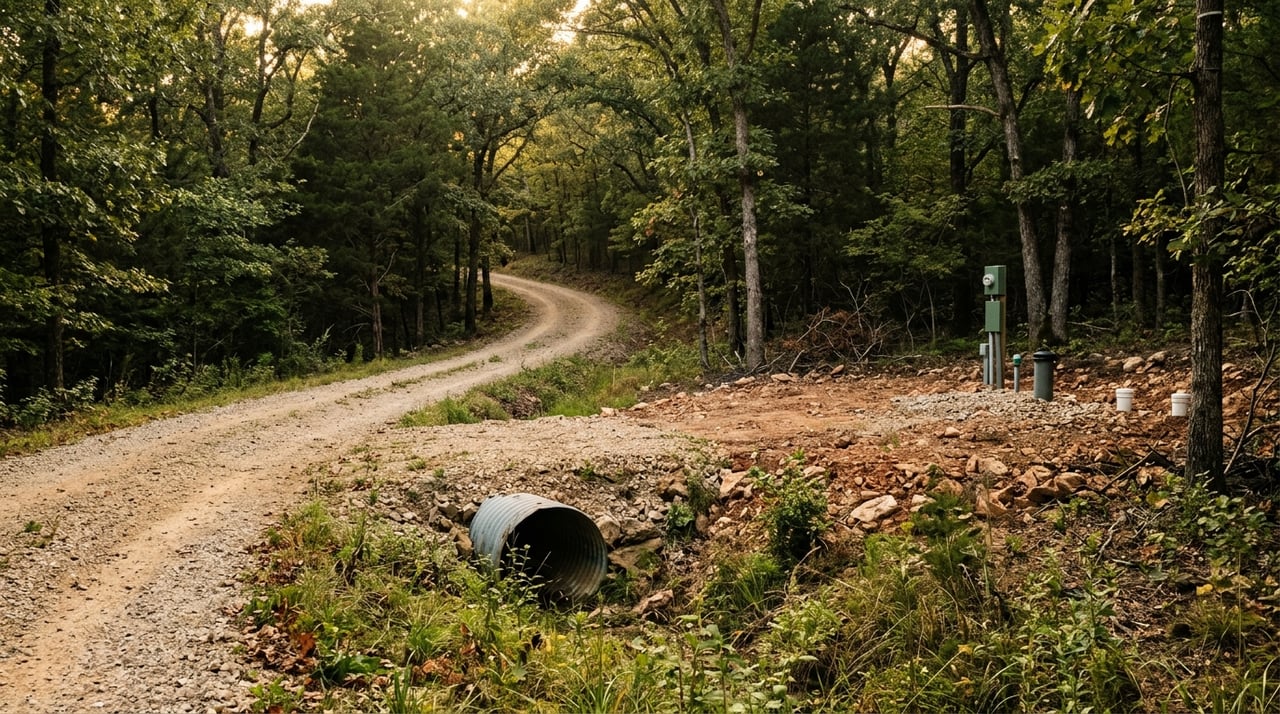
A dry-weather showing only tells part of the story. A road that works fine in a pickup on a sunny afternoon may be a very different experience after heavy rain or storm cleanup.
When you look at access, think about year-round use. Ask yourself whether guests, contractors, utility crews, or emergency vehicles could realistically reach the property if conditions change.
Utilities can change the real cost fast
Utility questions are where many recreational land buyers either save themselves a headache or inherit one. Near McAlester, the answer often depends on whether the property is inside city service areas or farther out in the county.
Inside McAlester, the city maintains utility billing and collection functions. Rural tracts, on the other hand, often require you to confirm whether the parcel will use a rural water district, a private well, septic, or a mix of services.
Water service is not one-size-fits-all
Some properties may have access to a rural water system. Pittsburg County has rural water infrastructure, and Pittsburg County Rural Water, Sewer, Gas, and Solid Waste Management District No. 14 received a $1 million Oklahoma Water Resources Board grant in 2024 for water infrastructure improvements.
Even so, you should never assume a nearby line means simple service for your tract. You need to ask the actual provider whether service is available, what extension may be required, and what that cost looks like.
Electric service needs practical verification
PSO’s McAlester District serves the City of McAlester and PSO’s southeastern Oklahoma service area. PSO also notes that some circuit mileage is inaccessible to bucket trucks and may require manual access.
For rural buyers, that can affect more than installation. It can influence line-extension planning, vegetation management, maintenance coordination, and restoration time after outages.
Provider rules matter too
In Oklahoma, the Oklahoma Corporation Commission regulates electric, gas, drinking water, and telecommunications utilities, but many cooperatives and municipally owned utilities are exempt from OCC rate regulation. In practical terms, the provider itself can affect service rules, complaint channels, and rate oversight.
That is one more reason to confirm the provider early. Two properties in the same general area may not operate under the same utility setup.
Wells and septic need early homework
If the property will not connect to public or rural utility systems, your next focus should be well and septic feasibility. These are not details to leave until the end of your due diligence.
A tract may look perfect for a cabin or homesite, but water depth, soil conditions, and septic placement can change both cost and usable layout.
Check nearby well records first
If you expect to use a private well, start with Oklahoma Water Resources Board records. OWRB licenses well drillers and pump installers and provides a groundwater well record search with nearby well logs, completion dates, depth to water, and yield data.
That does not guarantee your exact results on a subject property, but it gives you a much better starting point than guessing. Nearby well information can help you understand whether the area tends to require deeper drilling or has variable yields.
Septic starts with soil testing
If the property will need a septic system, Oklahoma guidance says the first step is a soil test. System components must be located on the owner’s property or within a dedicated recorded easement.
This is important on recreational land because shape, slope, and drainage can shrink the part of the tract that actually works for wastewater treatment. A property with plenty of acreage can still have a limited area for a compliant system.
Lot size and reservoir rules matter
OSU guidance says lots served by public water are typically 0.5 acres, while lots served by a private well are typically 0.75 acres. It also notes that properties within 300 feet of certain listed reservoirs or stream beds may require an advanced nitrogen-reducing system.
If you are looking near water features or low drainage areas, ask that question early. Septic design requirements can affect both budget and building plans.
Terrain shapes usable acreage
In recreational land, total acreage and usable acreage are not the same thing. Around McAlester, that difference can be significant because of hills, sandstone features, drainage lines, and creek-bottom ground.
A tract may offer privacy, wildlife cover, and good views, but still have limited space for building, driving, or parking equipment. That is why terrain review should be part of your first pass, not an afterthought.
Study slope and drainage patterns
USDA NRCS identifies Web Soil Survey as the official current source for soil information and custom property reports. For buyers, that is a practical tool for checking slope, drainage, wetness indicators, and broad limitations related to septic or building potential.
This kind of review can help you spot trouble before you fall in love with the wrong parcel. If a property includes steep grades or poorly drained sections, you want to know that before planning improvements.
Watch creek bottoms and low crossings
Because Pittsburg County includes major creeks, drainage lines, and watershed influence, low crossings deserve careful attention. A route that is easy to drive in dry conditions may become unreliable after rain.
If part of the tract sits near a creek bottom or a lake-adjacent low area, flood mapping and on-site review become even more important. Water can affect access, building placement, and how much of the property feels usable year-round.
Expect rock in some areas
USGS digital geologic mapping for the McAlester-Texarkana quadrangles can help buyers anticipate surficial geology issues such as shallow rock. That matters when you are estimating excavation, driveway cuts, or site prep.
In plain terms, a beautiful elevated homesite may come with tougher dirt work than expected. That does not make it a bad property, but it does mean the budget should match the terrain.
A smart touring checklist
Before you tour recreational land near McAlester, it helps to have a working checklist. That keeps you from focusing only on appearance and missing the items that affect cost and future use.
Here are the key points to verify:
- Confirm the exact access route and review the deed and survey for easement language, utility corridors, or mineral severance.
- Ask whether the road is public, private, or shared and whether a recorded road agreement exists.
- Contact the utility provider to confirm service availability, extension cost, and any vegetation or access issues that could affect maintenance.
- If the tract will need a well, review nearby OWRB well logs for depth-to-water and yield history.
- If the tract will need septic, order soil work early and ask whether the property falls within a Water Body Protection Area.
- Review flood mapping for creek-bottom, low-crossing, or lake-adjacent land.
- Use soil and terrain tools to compare the advertised acreage with the land you can realistically use.
What this means for your decision
The best recreational tract is not always the prettiest one on the first drive through. It is the one where legal access, utility planning, and terrain all support the way you actually want to use the land.
Near McAlester, that can mean slowing down long enough to ask better questions. A property with strong access, a realistic water and septic plan, and terrain that fits your goals will usually outperform a cheaper tract with hidden limitations.
If you want help sorting through acreage, access questions, and land-use fit in Southeast Oklahoma, Jeremy Grumbles can help you evaluate recreational property with a practical, boots-on-the-ground perspective.
FAQs
What should you verify first when buying recreational land near McAlester?
- Verify legal access first, including recorded ingress and egress, because a visible trail or gate does not necessarily mean the access is permanent or documented.
How do utilities usually work on rural land in Pittsburg County?
- Rural tracts may rely on a rural water district, a private well, septic, electric line extension, or a combination of services, so you should confirm availability and costs with each provider before moving forward.
Why does terrain matter so much on recreational land near McAlester?
- Pittsburg County has hilly ground, sandstone features, creek bottoms, and drainage areas, which can affect building sites, drivability, septic placement, excavation costs, and year-round usability.
What should you check before assuming a tract can support a well?
- Review nearby Oklahoma Water Resources Board well records for information such as completion dates, depth to water, and yield history to better understand local well conditions.
What should you know about septic systems on recreational property in Oklahoma?
- Septic planning starts with a soil test, and system components must be on the owner’s property or within a dedicated recorded easement, while some properties near certain reservoirs or stream beds may need advanced treatment systems.
How can you evaluate flood or wet-ground risk on land near McAlester?
- Review official flood maps for creek-bottom, low-crossing, and lake-adjacent tracts, and compare that with the property’s drainage patterns and on-site terrain conditions.